Puff Printing for Streetwear and Corporate Apparel: Two Very Different Use Cases
Puff printing works for both streetwear drops and corporate or brand merch, but the two use cases call for different design choices — streetwear tends to lean into bold, multi-color puff designs for visual impact, while corporate and brand apparel typically uses puff more selectively, on a single logo, for a clean, premium finish. The underlying technique is identical either way: plastisol ink mixed with a foaming additive that rises into a raised, 3D texture when heat-cured. What changes is how much of the design gets the puff treatment, and why.
What Makes Puff Printing Different from Standard Screen Printing?
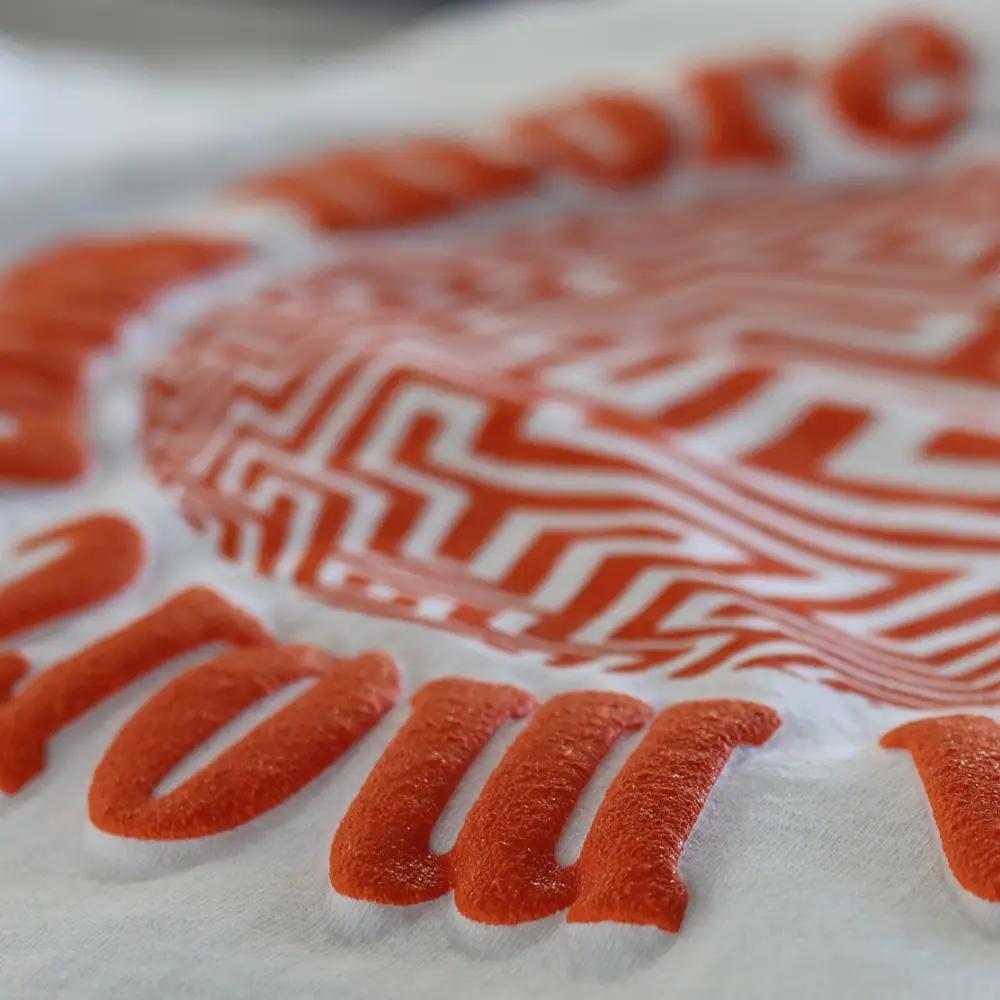
Puff printing uses the same mesh-screen, squeegee, and heat-cure process as standard screen printing, but the ink itself contains a foaming agent. When the printed garment passes through the conveyor dryer, that agent activates and the ink expands, settling at roughly 0.4–0.5mm of raised height. The effect is permanent and holds its shape through washing, giving the print a soft, tactile feel that reads as more premium than a flat design — which is exactly why it shows up so often in both streetwear and brand merch, just applied differently.
Both use cases share the same production minimums and timeline: a 50-piece minimum order, roughly two-week standard turnaround, and rush service available when a launch date is tight. What actually separates the two isn't the process — it's the design decisions layered on top of it.
Case Study: Puff Printing for a Streetwear Drop
For The Saddest Faction, a streetwear clothing brand, we produced 750 TeeStyled TS7000 t-shirts using puff plastisol ink in yellow, green, and red on black 100% cotton tees. The multi-color, high-contrast approach is typical of streetwear: the puff effect isn't limited to one small logo, it's part of a bold, full graphic design meant to be seen from across a room. The order was completed in 8 business days, with a sample photo approved before full production began.
This is where puff printing tends to go furthest in streetwear: large graphics, saturated colors, and heavy ink coverage that turns the raised texture into a visual centerpiece rather than a subtle accent.
Case Study: Puff Printing for Brand and Corporate-Style Apparel
For Swish Studios, we ran a 750-piece order of puff-printed 1801GD t-shirts alongside 350 LS14001 hoodies, using a large white puff design against black apparel. Unlike the multi-color streetwear approach, this project leaned on a single ink color for a cleaner, more controlled look — and it came with full retail finishing (folding, bagging, and size stickers) so the pieces arrived ready to sell rather than needing extra prep. That combination of a restrained color palette and retail-ready presentation is more typical of brand and company merch, where the goal is a polished, professional finish rather than maximum visual noise.
Streetwear vs. Corporate/Brand Puff Printing: Key Differences
Which Approach Fits Your Brand?
If you're building a drop or a collection meant to stand out visually, lean into puff printing the way streetwear does: bold shapes, saturated color, and full-coverage designs where the texture itself becomes part of the artwork. If you're producing uniforms, company merch, or client gifts, puff printing still works — just dial it back to a single-color logo and pair it with retail finishing if the pieces need to look shelf-ready or gift-ready out of the box.
Either way, the same design rules apply: puff performs best on cotton or cotton-blend fabric, with bold shapes and clean lines rather than fine detail, gradients, or small text under about a quarter-inch tall.
Talk to Our Team
Whether your project looks more like a streetwear drop or a corporate order, our puff screen printing team can help you figure out how much puff coverage, how many colors, and what finishing makes sense for your specific design.
Request a quote and hear back within two hours.